- +302651401828, +306950100818
- info@memo-shoes.gr



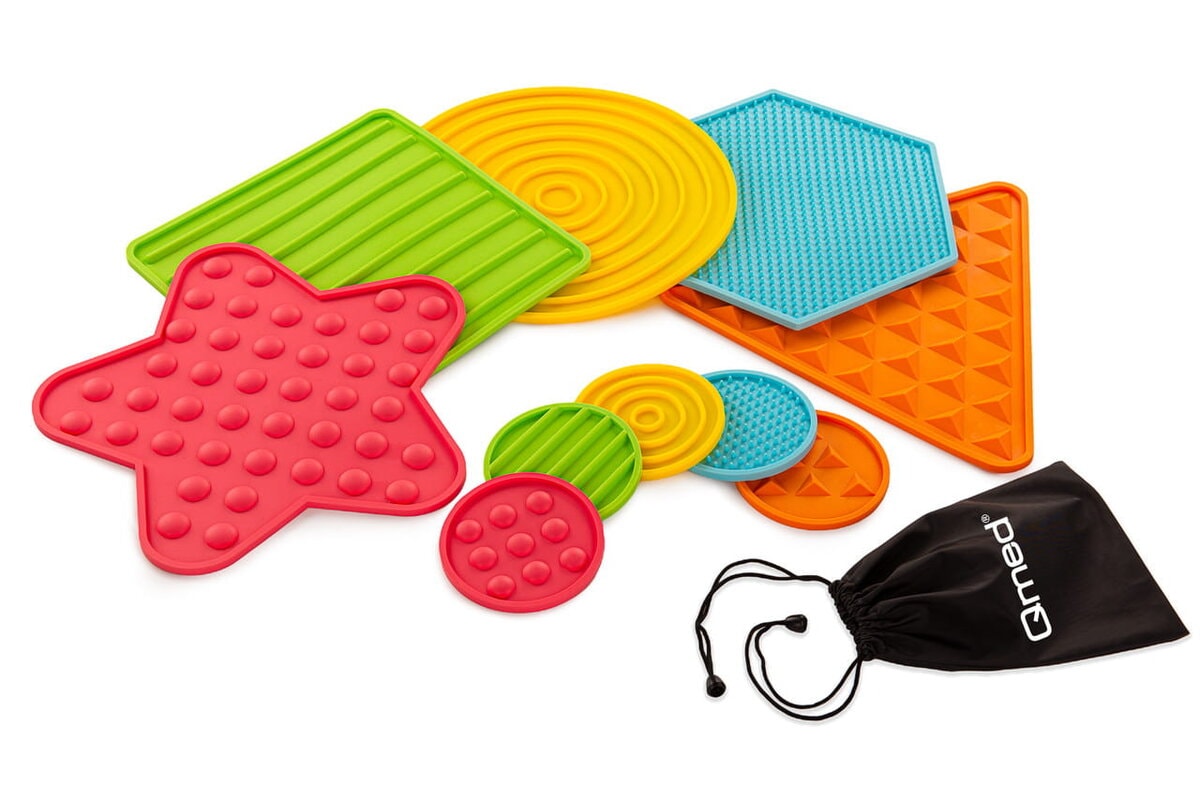

Sensory Path for Children
- Manufacturer : MDH

- Availability : Available in 10 days
- Perfect for improving sensory perception.
- Wide range of sensory stimulation.
- Easy-to-clean material.
The sensory path set for children is created according to sensory integration theory (SI) by A. Ayers, educational psychology doctor and occupational psychotherapist. During child development, deficiencies may appear in the form of incorrect integration of multiple senses. According to Ayers, this can be attributed to ineffective functioning of brain neurons, a problem that can be compensated by providing required stimuli.
The nervous system is characterized by its plasticity, which is supported and stimulated by sensory stimuli. According to SI theory, the enriched environment in which a person lives facilitates the development of the brain. Changes occurring under the influence of stimulation are very dynamic, can be seen quickly and can be often documented in the brain structure. Depending on the person and environment, the changes can also be long-lasting.
Researches in the field of SI theory confirm that active exploration of the environment and childrens' involvement in tasks are necessary conditions for the occurrence of neural changes. It is very important to diversify the objects and items contacted during the development stage, as well as having a sufficiently long exposure that it is not a one-time experience, but a practice that lasts often enough. Engaging multiple senses of the complexity of the object or task are effective and necessary tools for positive changes in the nervous system. Practitioners and researchers working with the SI method claim that playing is a natural and highly motivating way to stimulate a child, especially when initiated by the child.
Exercises using the sensory path set for children involve:
- Motor skills and motor coordination.
- Movement planning according to environment perception.
- Visual sight and verbal communication.
- Development of social skills during playtime.
- Self-awareness and focusing on tasks.
Indications:
- Supporting the natural process of a child's development.
Usage:
- Plan the game on a flat and straight surface.
- The set consists of 10 textured shapes made of very soft, flexible silicone - 5 large and 5 small pieces.
- There is a pattern on the surface of each element that is distinctive and different from the rest of the set.
- Children can feel these textures and discover their differences by placing small circles in provided bag and see if they are able to describe or predict the pattern they are feeling.
- Connecting small and large sensory shapes by touch is also great fun.
Warning: Do not use in case of skin trauma. Always use under adult supervision.
Maintenance: Wash in warm water with soap after use. Dry away from artificial heat sources. Keep away from sharp objects. Do not roll.
Composition: Medical silicone
Size: Diameter 280 mm and 10 mm.
Age: 3+
Maxium load: 200 kg
Suggested products
BACK TO TOP