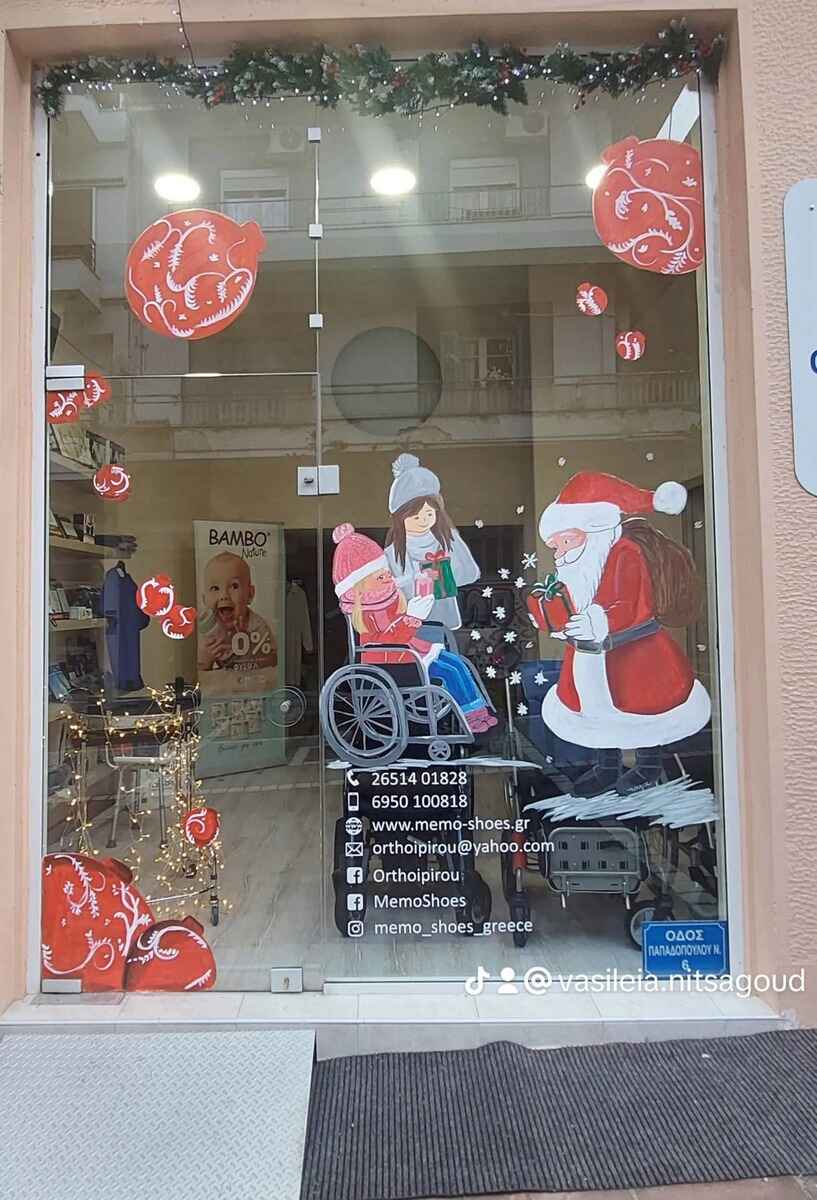




What does "Santa Claus" really mean and how does he still manage to fascinate children? How much do children need the myth of Santa Claus? What contributes and preserves the myth throughout the centuries? Do we need to keep his myth in children? These are some of the questions that parents are concerned about these holidays!
Named Santa Claus, the Orthodox Church commemorates him on January 1st. He was an educated and active man. Although he died at the age of 49, very poor the work of his life was very important and "rich" since he was very active. He became known for his work in charity, always caring for those in need. Over the centuries, this figure was maintained either as a medieval hiker, or as a New Year's Santa Claus or as a New Year's Santa Claus.
It exists as a welcome visitor that every 1st of the year starts from Caesarea of Cappadocia and travels around the world offering happiness and joy! For centuries now he undertakes to make children's dreams come true, he is always consistent in his arrival, every year, on Christmas and New Year, he always comes, loaded with gifts for children. The children are waiting for him impatiently, to leave them under the Christmas tree the gifts and toys they asked for, through their letters and wishes, he makes their wishes come true, aiming to make them smile from her happiness surprise!
The parents of the children, who recognize him as a friend and ally of the children, have made a significant contribution to the preservation of the myth. Young children are attracted to everything that contains mystery, so we realize that to Santa's assets is added the fascinating mystery of his existence. Children's questions such as: where does he live? Where does he live; How does he manage to be consistent every year in his appointment? Since it is thick, how does it fit in the chimney? How does he know what gift I wanted? Why doesn't he come to my party too? How does he manage to distribute gifts to all the children? Where does he get the money to make the toys? Questions like these, and their answers take shape in the child's mind, and create a very solid "ground" a very good basis for interesting discussions between children and parents, something that works as a support for the extension of development and preserving the myth of Santa Claus. Yet another element that can contribute to the preservation of the myth, making the Saint more fascinating, is the anticipation of the days, the gifts, and the surprise that follows.
But at what age do children need this preservation of the myth in the person of Santa Claus? The preservation of the myth, and when this fiction is stopped, represents each child depending on the developmental stage he is going through. The dilemma that parents come to choose is when is the appropriate period and age of the child, so that it is neither too small nor too big. The answer to this difficult question is that every child, depending on his temperament and personality, needs a different approach. It is important to maintain a balance that will neither hurt the child's "imagination" nor degrade his intelligence.
However, the figure of Santa Claus is a source of inspiration for all children, a source of joy, celebration and creation, it is useful to let them feel these emotions that come from the myth, magic, imagination! In this way, without censorship, we give children the supplies of optimism that later, growing up, can be supported on the road to face the difficult reality.
On the other hand, if we do not want to misinterpret reality to children, we can tell them the true story of Santa Claus and tell his life. Relying that the Saint loved children very much, and always wanted everything to be happy and joyful, and in the depths of the centuries parents to honor his memory give gifts of love.
If you decide to tell the truth to the children or not, at some point when they grow up they will be able to perceive it on their own and understand your attitude and your decision. The children are capable, and in their own way they will show us until they never need "Santa Claus", and they never really need to believe in the way they believed until now, in the feeding old man with the crimson uniform and the long beard that carries the toy bag every year!