

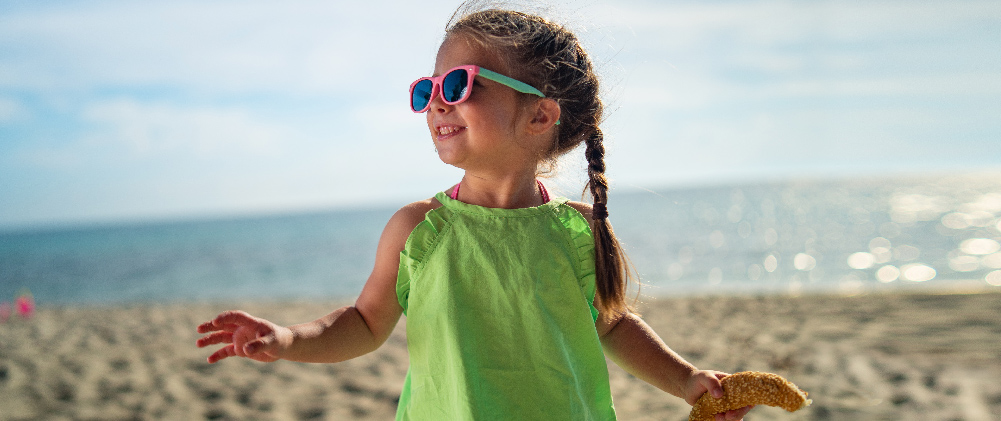
Hat, sunscreen, light clothes επιχείρηση The operation "protection of the child from the sun" is completed, and you are ready for another getaway in the park, the countryside, the sea with your little one. But is it over or have you forgotten something? Yes, you forgot something very important: protecting his sensitive eyes from the sun!
As much as it sounds - still - excessive for some, sunglasses are not an unnecessary accessory that complements the stylistic choices of your little one. It is now a very serious matter. And mainly it is not something that concerns only the summer months or the hours you are on the beach. It is - or should be - a way of life for the… eyes of the child.
But why are sunglasses necessary? We now know that after the depletion of the protective layer of ozone, the sun's ultraviolet rays are a serious threat to our body - which is why we try to ensure the protection of our skin from this dangerous invisible radiation. But we do not show the same interest in protecting our eyes. And yet sunlight is just as dangerous to our eyes and our sight. Here's how: Sunlight reaches the eyes directly or indirectly from reflection on other surfaces such as sand or sea. 99% of this radiation is absorbed by the anterior parts of the eye, ie by the cornea and the lens, while a smaller amount passes and reaches the retina.
The results of more and more studies today leave no room for complacency: exposure to ultraviolet radiation is associated with the occurrence of many vision problems - cataracts, fin, macular degeneration, and even tumors in the eye area, are some of them. In fact, experts point out that radiation damage is caused by accumulation, ie the harmful effect is added up and eventually any problems occur.
It is obvious that the earlier the sun protection starts, the less likely we are to have vision problems. After all this, does the issue of sunglasses for your little one still seem absurd and excessive?
What you need to know before buying sunglasses:
- Young children under 3 years old have a hard time holding sunglasses on their face. They see them as an annoying accessory and often destroy them. If your child does not accept sunglasses, choose a hat.
- Choose glasses that have certification that proves 100% absorbency, for all ultraviolet rays, ie for UV-B and UV-A
- Better to prefer glasses with not too dark lenses The choice of light colored lenses has an important advantage: children will get used to them and will wear them more easily playing under the umbrella or in the car. Because the aim is not to wear them only in the sun but also under the shade, where the radiation is reflected and reaches the children of the eyes.
- There are sunglasses, as you will find out from your visit to an optician, for all ages and all tastes. What you need to keep in mind when choosing is that the lens material must be made of special unbreakable plastic to avoid the possibility of injury.
- It is important that the glasses stand firmly on the child's face. They can e.g. to be fastened with a rubber band behind the head. There are now sunglasses that instead of arms (which is the vulnerable point of children's glasses) have rubber. You can also find glasses with a strap that "ties" around the child's head, ensuring comfort in his movements. If you again choose a classic frame (for an older child) then the string or the clip that "catches" on the clothes is a good solution so that the glasses do not break when they fall (which will fall!) Down.
- The first.. Contact with the object is decisive for the relationship that the child will have with him from now on. An important detail to pay attention to when the child is under three years old concerns the construction of the frame of the glasses in relation to the anatomy of his -still shaped- face. The glasses should not be too tight and should not touch his eyelashes or eyes and generally should not press on his head because he will combine them with discomfort and will not wear them pleasantly. Also, the wide deformed base of the nose often does not offer sufficient support to the frame of the glasses. The use of a special "saddle" made of silicone can help in the easier and safer application of the glasses.
Source: https://www.iatriko.gr/el/content/paidi-kai-gyalia-ilioy?cl=609